
Clinton County Court Records After a Jail Arrest
After a Clinton County arrest, the custody record and the court record separate quickly. The jail or arresting agency may hold booking facts, intake details, arresting-agency information, and custody status. The Kentucky Court of Justice record tracks the filed case after it reaches court. For Clinton County, the court-record route runs through the Clinton County Courthouse at 100 S. Cross St., Albany, KY 42602. Circuit Court Clerk Jake Staton is the local court-record contact listed by the Kentucky Court of Justice, with phone numbers (606) 387-6424 and (606) 387-8181.
That distinction matters when someone is trying to understand what happened after a jail arrest. A booking entry may reflect the reason for arrest at intake, but filed court records show the charges that are actually before the court. For current custody and local jail-routing questions, use jail inmate records. For booking-photo availability and mugshot-specific limits, use jail mugshots. For the criminal case itself, focus on the Kentucky Court of Justice docket, court-record request process, the circuit clerk, and the prosecutor offices that handle filed charges.
The Kentucky Court of Justice Clinton County page is the local court anchor for courthouse and clerk information.
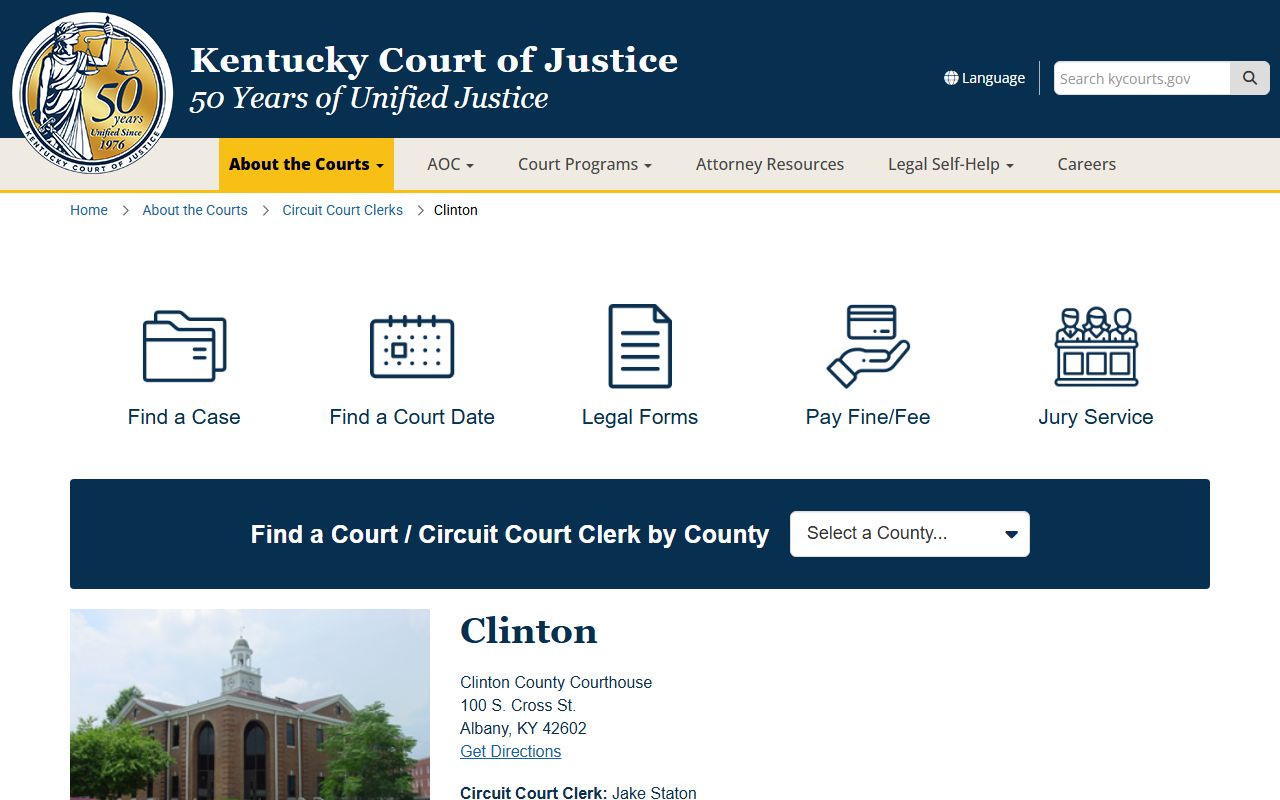
Use that court page for Clinton County courthouse routing before relying on older directory listings or general search results.
How to Find Clinton County Court Records After an Arrest
Start with the court system when the question is about filed charges, hearings, bond orders, or disposition. Clinton County criminal matters may begin in District Court, especially for misdemeanors, violations, traffic cases, arraignments, and felony probable-cause hearings. Circuit Court is Kentucky's general-jurisdiction court and handles felony matters after the early stage. A recent jail arrest may not immediately appear in every court search, so a careful lookup uses several channels instead of treating one search result as complete.
- Confirm the person's exact name and, when available, date of birth or case number so the court lookup is not confused by similar names.
- Open the Kentucky Court of Justice public docket and choose Clinton County with the correct division and date range for the expected hearing.
- For copies or verified case records, call or visit the Clinton County Circuit Court Clerk at the courthouse where the case was handled.
- Use KYeCourts guest access for public court access when the portal is available, understanding that access terms and session limits may apply.
- Use FastCheck for statewide criminal-record reports when the need is a broader background report rather than a live jail roster or single docket date.
The Kentucky public docket search is useful for upcoming court dates after an arrest, but it is not a full criminal-history report and the docket information is subject to change.
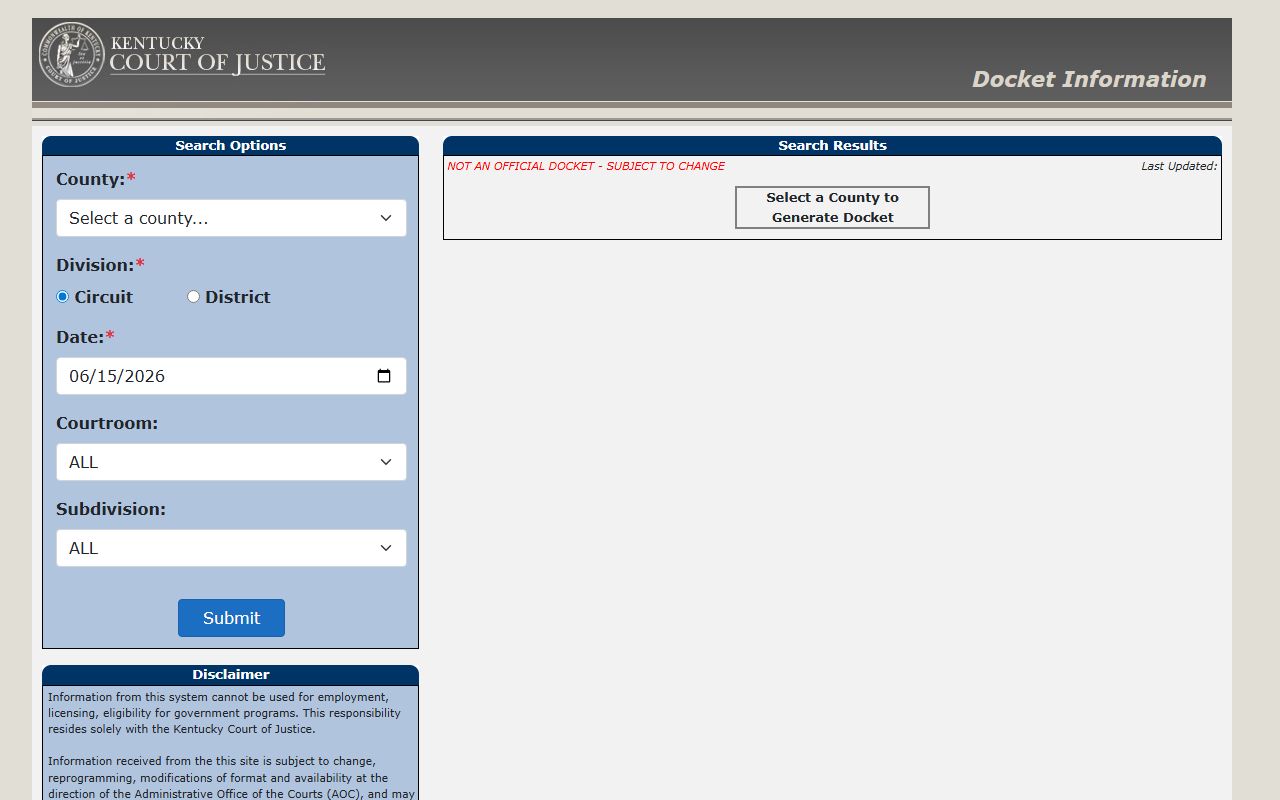
The docket screen is best read as a court-date tool, not as proof that every charge, warrant, or final disposition has been captured.
Court Docket Search Fields
| Field | How It Helps a Clinton County Search |
|---|---|
| Division | Choose Circuit or District depending on the case stage and charge type. District Court often handles early appearances and misdemeanors; Circuit Court handles felony matters beyond the early stage. |
| Date | Use the expected court date, first appearance date, or a nearby date if the hearing is still being scheduled. |
| Courtroom | Leave broad when unknown. Narrowing too early can hide a docket entry if the courtroom assignment changed. |
| Subdivision | Use only when the court has supplied a specific subdivision. Otherwise, keep the search broad. |
| County | Select Clinton County to generate the local docket for Albany court proceedings. |
| Submit | Runs the docket request after the required fields are selected. |
Requesting Court Records After a Clinton County Arrest
A docket entry can point to a hearing, but it is not the same as a certified or complete court file. The Kentucky Court of Justice court-record request process directs circuit and district case-record requests to the circuit court clerk in the county that handled the case. For Clinton County, that means Circuit Court Clerk Jake Staton at 100 S. Cross St., Albany, KY 42602, with phone numbers (606) 387-6424 and (606) 387-8181. Call before traveling if the record is old, sealed, expunged, or tied to a case still moving through court.
The Kentucky court-record request instructions explain that case-record requests begin with the circuit court clerk for the county where the case was handled.
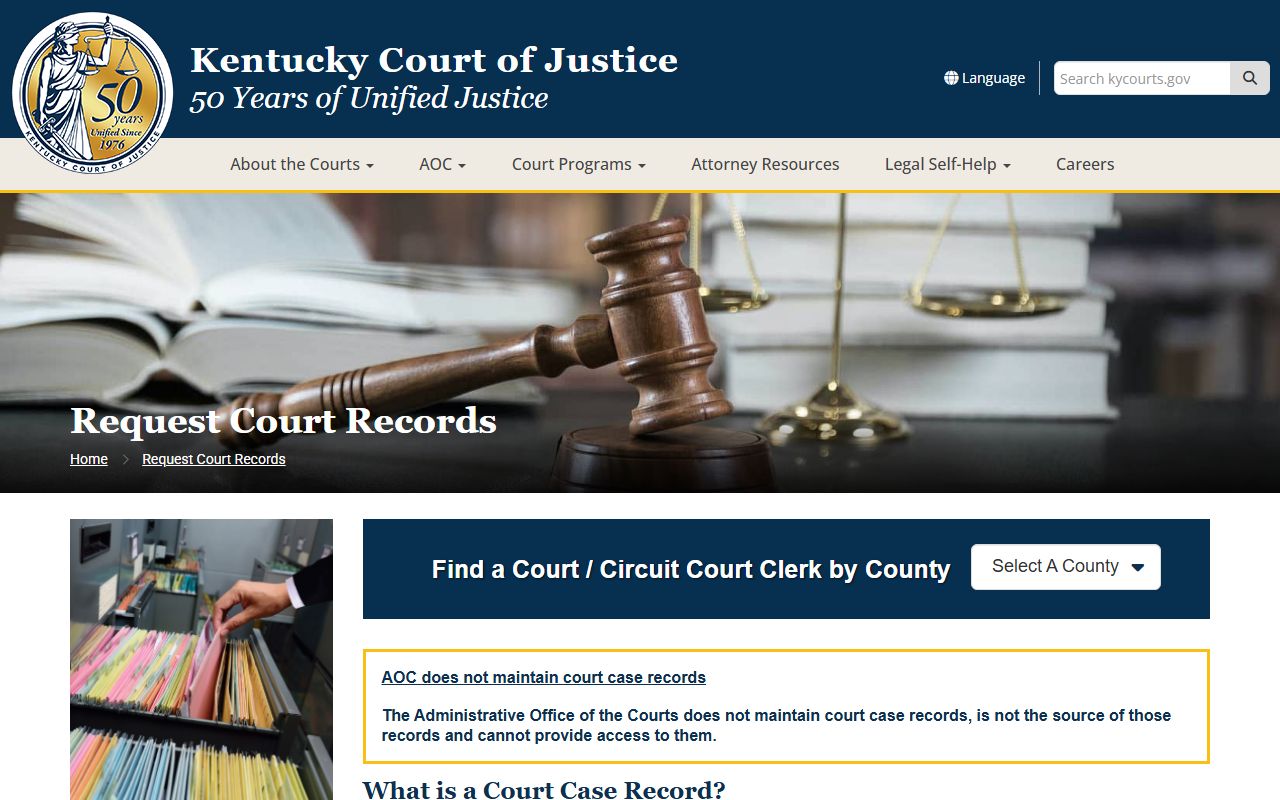
For a Clinton County case, that request route is more reliable for copies than a general web search for arrest records.
The KYeCourts guest login is another Kentucky Court of Justice access point for public court access.
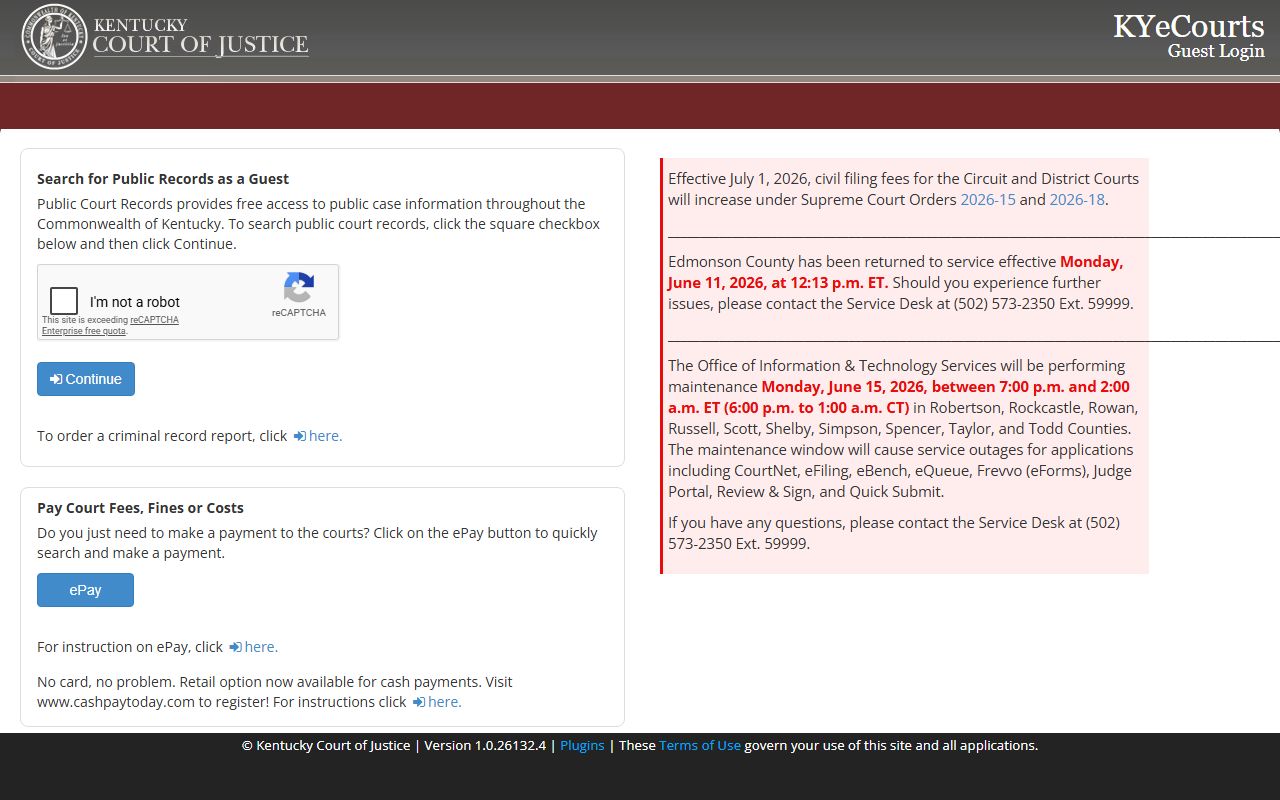
Guest access should be treated as a court-access channel with terms and limits, not as a substitute for the clerk when a verified copy is needed.
How Charges Get Filed After an Arrest: Complaint, Information, and Indictment
The arrest-to-court path starts with booking, but the criminal case moves on charging documents. A complaint may begin a prosecution in lower court. An information is a prosecutor-filed charging document. An indictment is returned by a grand jury and often appears in felony circuit-court practice. Clinton County's prosecutor track is split under Kentucky practice: County Attorney Michael Rains is the county attorney listed by the official county material, while Commonwealth's Attorney Jesse Stockton handles the 40th Circuit felony prosecutor role for Monroe, Cumberland, and Clinton counties.
| Complaint | Information | Indictment | |
|---|---|---|---|
| Filed By | Usually an officer or prosecutor in the early case path. | Prosecutor. | Grand jury, then filed in court. |
| Common For | Early District Court matters, misdemeanors, violations, and initial felony proceedings. | Cases where the prosecutor proceeds without an indictment when allowed by law and procedure. | Serious felony matters that move into Circuit Court. |
| Starts | The court case or early charge record after arrest. | A formal prosecution path in the court record. | A felony circuit-court case or a new felony charging stage. |
| Why It Matters | May differ from jail booking language. | Can reflect prosecutor decisions after review. | Can replace or refine earlier arrest-based charges. |
Charge Status in Court Records After a Jail Arrest
Charges may change after a Clinton County jail arrest. A jail intake description can be an arrest snapshot, while the court record reflects what prosecutors and courts do with the case. A charge may be pending, amended, reduced, dismissed, resolved by plea, set for trial, or closed by another disposition. Treat each charge line separately because one case can include several counts with different statuses.
| Status | What It Means | Why It Matters |
|---|---|---|
| Pending | The charge remains unresolved and the court process is still active. | Future dates, bond conditions, motions, and negotiations may still affect the result. |
| Amended | The charge language, statute, count, or allegation changed after filing. | The final court record may not match the jail booking description. |
| Reduced | The charge moved to a lesser offense or lower level. | Penalties, court jurisdiction, and background-check treatment can change. |
| Dismissed | The charge was not pursued to conviction by the court record. | Dismissal is not the same as expungement; public access may still depend on later court action. |
| Convicted | Guilt was entered by plea or found by the court or jury. | The record now shows a conviction rather than only an arrest or accusation. |
| Diversion or Probation Path | The case may involve supervised conditions instead of immediate jail or prison time. | Completion, violation, or revocation can create later court entries. |
Bond and Release After an Arrest
Official Clinton County bond-posting instructions were not published in the reviewed sources, so bond should be handled as a verification workflow. Bond is set through the court process, and a court order controls release conditions. A jail cannot release a person if a judge's order, another-agency hold, parole or probation hold, detainer, or no-bond condition blocks release. Before traveling to post money or sign paperwork, verify the inmate's exact name and date of birth, current custody status, court case status, accepted payment methods, office hours, and whether any outside hold exists.
| Bond Type | How It Works |
|---|---|
| Cash Bond | Money is posted under the court's bond order. Confirm where and when payment is accepted before traveling because no official Clinton County online bond portal was located. |
| Surety Bond | A licensed bail bond agent may post the bond under Kentucky practice. Confirm that the bond is permitted and that no hold prevents release. |
| Property, Unsecured, or Percentage Bond | Some Kentucky cases may use non-cash or partial-payment structures, depending on the judge's order and case type. |
| PR / Own Recognizance | The person is released on a promise to appear and comply with court conditions, without posting full cash bond. |
| No-Bond Hold | Release is blocked unless the court changes the order or the holding agency clears the detainer or hold. |
Bond is only one part of court records after an arrest. A released defendant may still have arraignment, preliminary hearing, pretrial conference, plea, trial, sentencing, probation review, or compliance dates. The docket can help locate those dates, but the circuit clerk is the better contact for confirmed court-record questions.
Warrants That Lead to an Arrest and Court Records
No official Clinton County active-warrant search page was located in the reviewed county sources. The county site did not publish a warrant list, most-wanted page, or warrant-search form. Do not treat unofficial warrant aggregators as a confirmed county source. For law-enforcement routing, the Clinton County Sheriff's Office can be contacted at (606) 387-5111. For court-case status or warrants tied to a court case, call Circuit Court Clerk Jake Staton at (606) 387-6424 or (606) 387-8181.
A warrant arrest can produce a jail booking and later court records, but the type of warrant matters. An arrest warrant authorizes custody on a criminal allegation. A bench warrant is commonly issued by a judge after a missed court appearance or court-order violation. A search warrant authorizes a search of property and is not itself a custody warrant. A fugitive warrant, detainer, or another-county hold can keep a person in custody even after the local Clinton County charge appears bondable or resolved.
Prosecutor Offices in Court Records After a Clinton County Arrest
Kentucky does not use the district attorney label the same way some states do. Clinton County prosecution is divided between the county attorney and the Commonwealth's Attorney depending on charge type and procedural stage. County Attorney Michael Rains is listed by the official county material with phone (606) 387-0780 and fax (606) 387-3277. The felony prosecutor for the circuit is Commonwealth's Attorney Jesse Stockton, 40th Circuit, serving Monroe, Cumberland, and Clinton counties from 201 North Cross Street, Albany, KY 42602, phone (606) 387-8458.
The Kentucky Attorney General attorney directory lists Commonwealth's Attorney contacts, including the 40th Circuit entry for Clinton County.
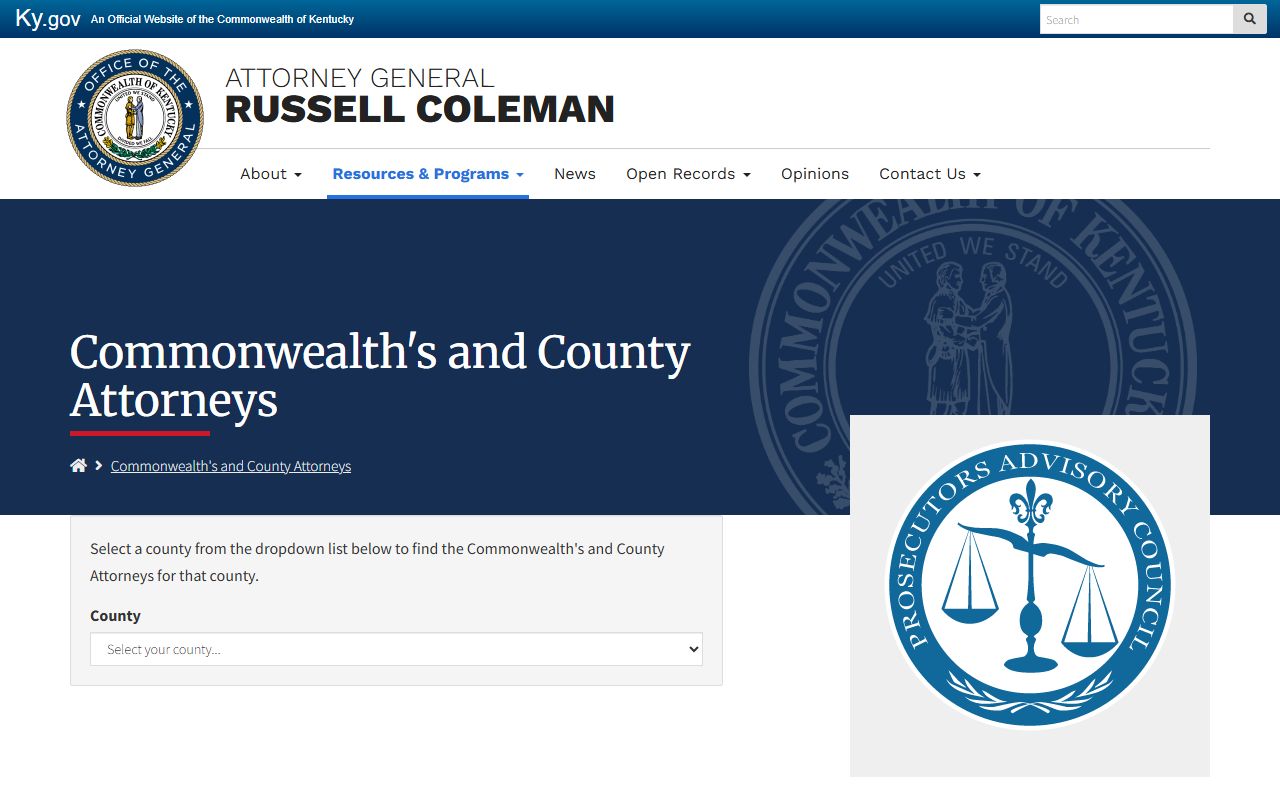
Prosecutor information helps explain why arrest-based charges may later be amended, reduced, dismissed, indicted, or resolved by plea or trial in the court record.
Charges vs. Convictions
An arrest and a filed charge are not the same as a conviction. Court records after a jail arrest may show allegations long before the court reaches a final outcome. A person can be arrested, booked, charged, and released without being convicted. A conviction appears only after guilt is entered by plea or found by the court or jury.
| Charge | Conviction | |
|---|---|---|
| Stage | Accusation filed in court after arrest or prosecutor review. | Final guilt result by plea, verdict, or adjudication. |
| Proof Level | May begin from probable cause or prosecutor filing decisions. | Requires proof beyond a reasonable doubt or a valid guilty plea. |
| Public Record | Often public unless sealed, confidential, expunged, or otherwise restricted. | Often public unless expunged, vacated, sealed, or legally restricted. |
| Practical Reading | Do not describe the person as convicted based on the charge alone. | Check sentence, probation, appeal, expungement, or later court orders before relying on the outcome. |
Sealed vs. Expunged Court Records After an Arrest
Kentucky public access is shaped by open-records laws, court rules, confidentiality rules, and expungement statutes. KRS Chapter 61 provides Kentucky's open-records framework for public inspection, subject to exemptions. KRS 431.073 governs applications to vacate and expunge certain felony convictions. Expungement eligibility depends on the charge, disposition, timing, prior record, and the specific statute or court order. A dismissal does not automatically mean every public trace disappears.
The Kentucky Revised Statutes Chapter 61 open-records page is the statewide legal framework for public-records access, while court expungement questions should be checked through Kentucky Court of Justice resources and legal counsel.
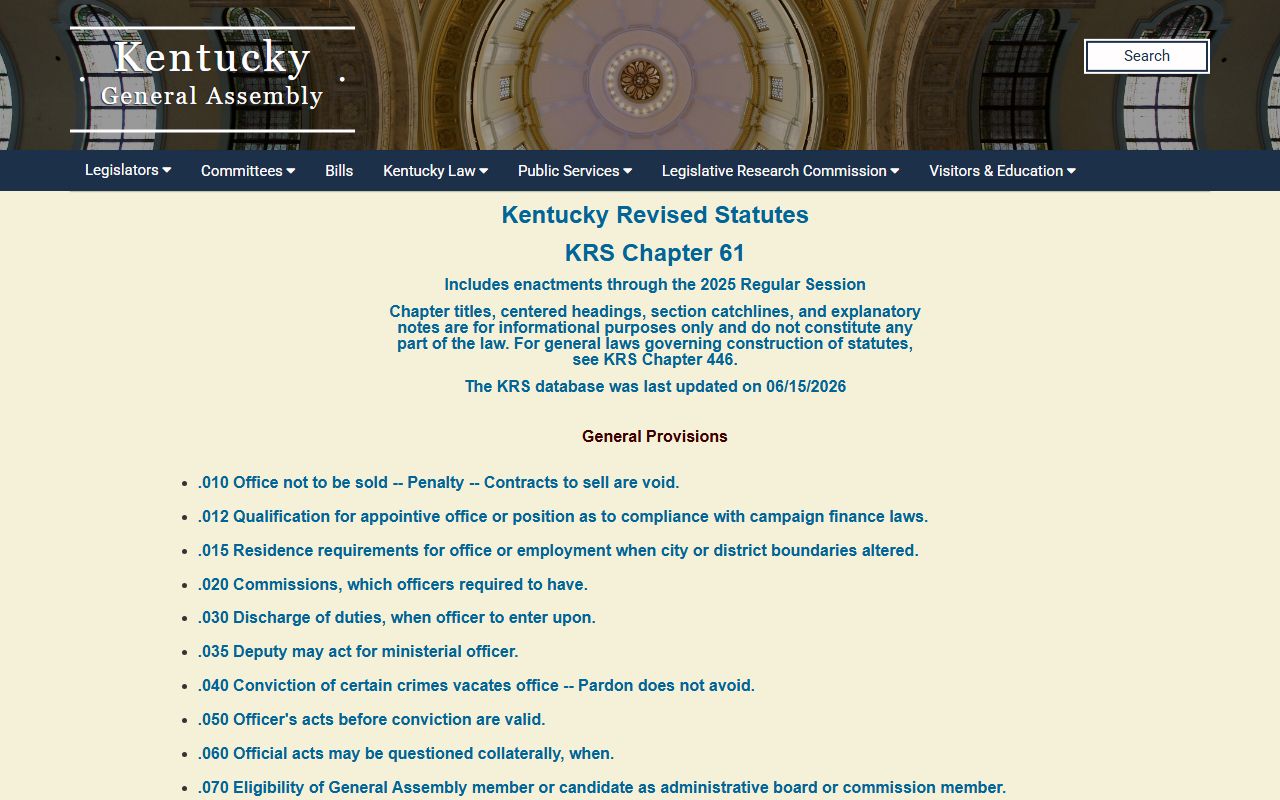
Open-records access and expungement relief are different legal concepts, so a request for copies and a request to clear a record follow different paths.
| Sealed | Expunged | |
|---|---|---|
| Public Visibility | Hidden from ordinary public access by court rule or order. | Removed from public access and treated under the applicable expungement law. |
| Record Status | The record may still exist with restricted access. | The record is vacated, expunged, or handled as the statute and order provide. |
| Who May See It | Access may remain for courts, law enforcement, or authorized agencies. | Access after expungement depends on Kentucky law and the particular order. |
| Eligibility | Often tied to confidentiality, juvenile status, sensitive information, or a specific court order. | Depends on Kentucky expungement statutes, case outcome, waiting periods, and court approval. |
FastCheck and Background Check Considerations
FastCheck is a Kentucky Court of Justice criminal-record report channel, separate from a jail roster and separate from a single court docket search. It can be useful when the question is broader than one Clinton County court date, but it should not be used to guess current custody or bond status. A live arrest, a pending case, and a completed criminal-record report can show different information because they come from different systems and update on different timelines.
The Kentucky FastCheck and background-check page explains the state's criminal-record report options.
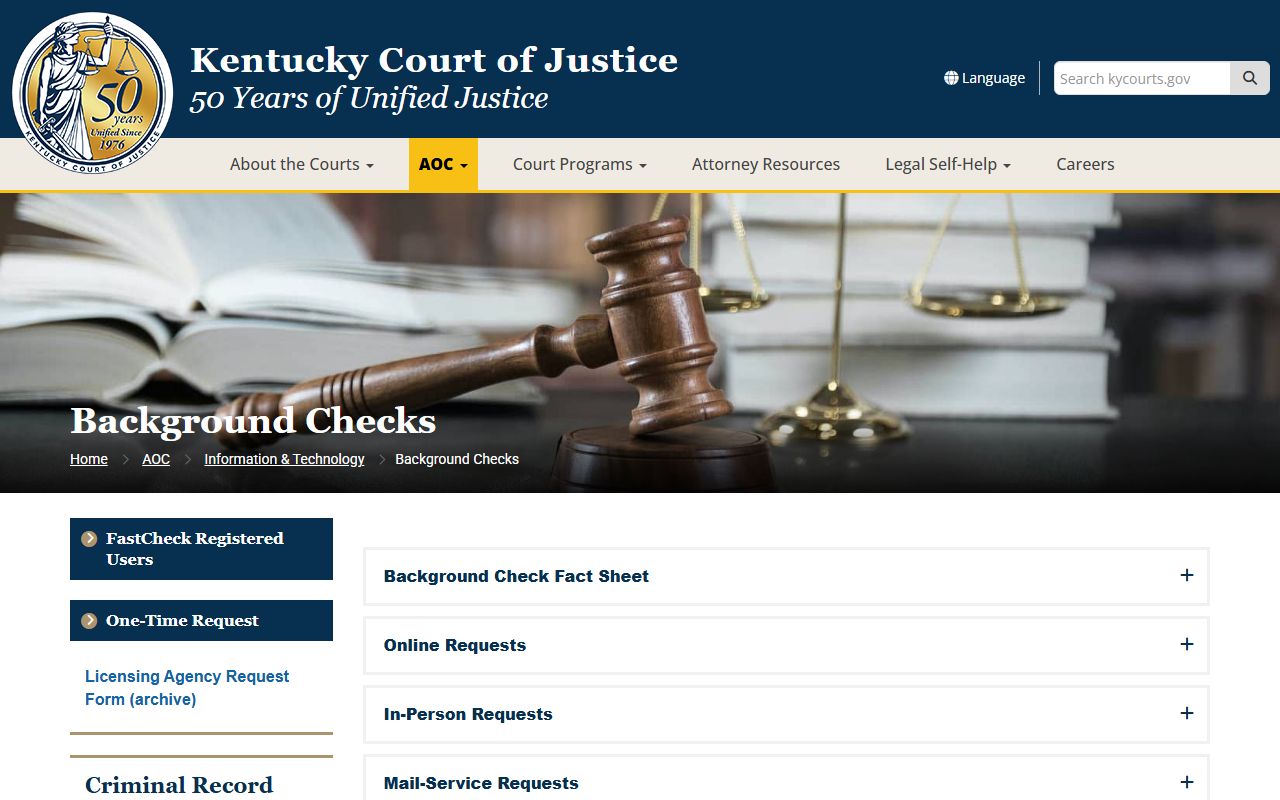
Use FastCheck for statewide criminal-record reporting needs, then verify any Clinton County case details through the circuit clerk or court docket.
Important: Clinton County Inmate Population is not a consumer reporting agency, and its information may not be used for FCRA-covered decisions.
Restricted Court Records After an Arrest in Clinton County
Not every arrest-related record is available to the public. Juvenile matters, sealed cases, expunged records, confidential victim information, active investigative material, and records restricted by court order may be withheld or limited. Kentucky Open Records may support requests for nonexempt agency records, but exemptions and court restrictions still matter. For filed charges, court dates, docket entries, and case copies, route the question to the Clinton County Circuit Court Clerk and Kentucky Court of Justice systems. For arrest reports or law-enforcement records, route the request to the sheriff or arresting agency. For DOC custody after sentencing, use Kentucky DOC's KOOL system rather than the Clinton County court docket.